Simons Center for the Social Brain
  • Our Research
    • Impact
      • Reaching beyond MIT
    • Targeted Projects
    • Postdoctoral Fellowship Research
    • Seed Grants
    • Technology Hubs
  • Our People
    • Investigators
    • Postdoctoral Fellows
      • Postdoctoral Fellows
      • Simons Postdoctoral Fellows: In their own words
    • Simons Center MSRP Summer students
  • Apply For Funding
    • Targeted Project Funding
    • Postdoctoral Fellowship Funding
  • Events
    • SCSB Events Overview
    • Colloquium Series
    • Lunch Series
    • UnrulyArt Program
    • Special Events
    • Past Events
      • Past Colloquium Series Speakers
      • Past Lunch Series Speakers
      • Past Special Events
  • News
    • SCSB Newsletters
  • Our Values
  • Support Us
    • Support Our Research
    • Participate in Research
  • Contact Us

Home

»

News

»

SCSB News

»

Leveraging genetic diversity to drive precision medicine

Leveraging genetic diversity to drive precision medicine

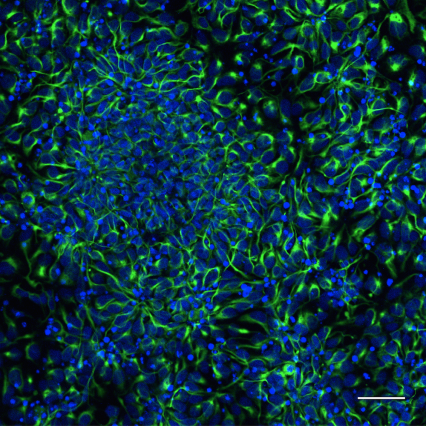
Sur-Fieldman-Picower-MIT1
Human neuron progenitors express neural stem cell marker Nestin (green). Image courtesy of Danielle Feldman, Sur laboratory, Picower Institute at MIT.

[Source: Picower Institute for Learning and Memory, October 16, 2015]

Taking advantage of genetic heterogeneity in autism and other neurodevelopmental disorders could lead to precision therapies.

Genetic research suggests that hundreds of genes are likely risk factors for neurodevelopmental disorders such as autism. This heterogeneity presents both challenges and opportunities when it comes to developing effective treatments for these diseases. The next generation of research must focus on the neural circuits underlying behavioral symptoms, the cell types in these circuits, and the signaling pathways that connect the diverse genes that potentially cause disease.

In a new paper in the journal Science, Mriganka Sur, professor at the Picower Institute for Learning and Memory and MIT Department of Brain and Cognitive Sciences, and Mustafa Sahin of Boston Children’s Hospital explain why leveraging the heterogeneity observed in autism spectrum disorder (ASD) will empower scientists to develop the precision therapies required to successfully treat the disease and others like it.
Read more…

SCSB_Newsletter_Fall-2025_cover

Contact Us:

Simons Center for the Social Brain
43 Vassar Street
MIT Building 46, Room 6237
Cambridge, MA 02139
Accessibility

· © 2025 Simons Center for the Social Brain · ·

keyboard_arrow_up